
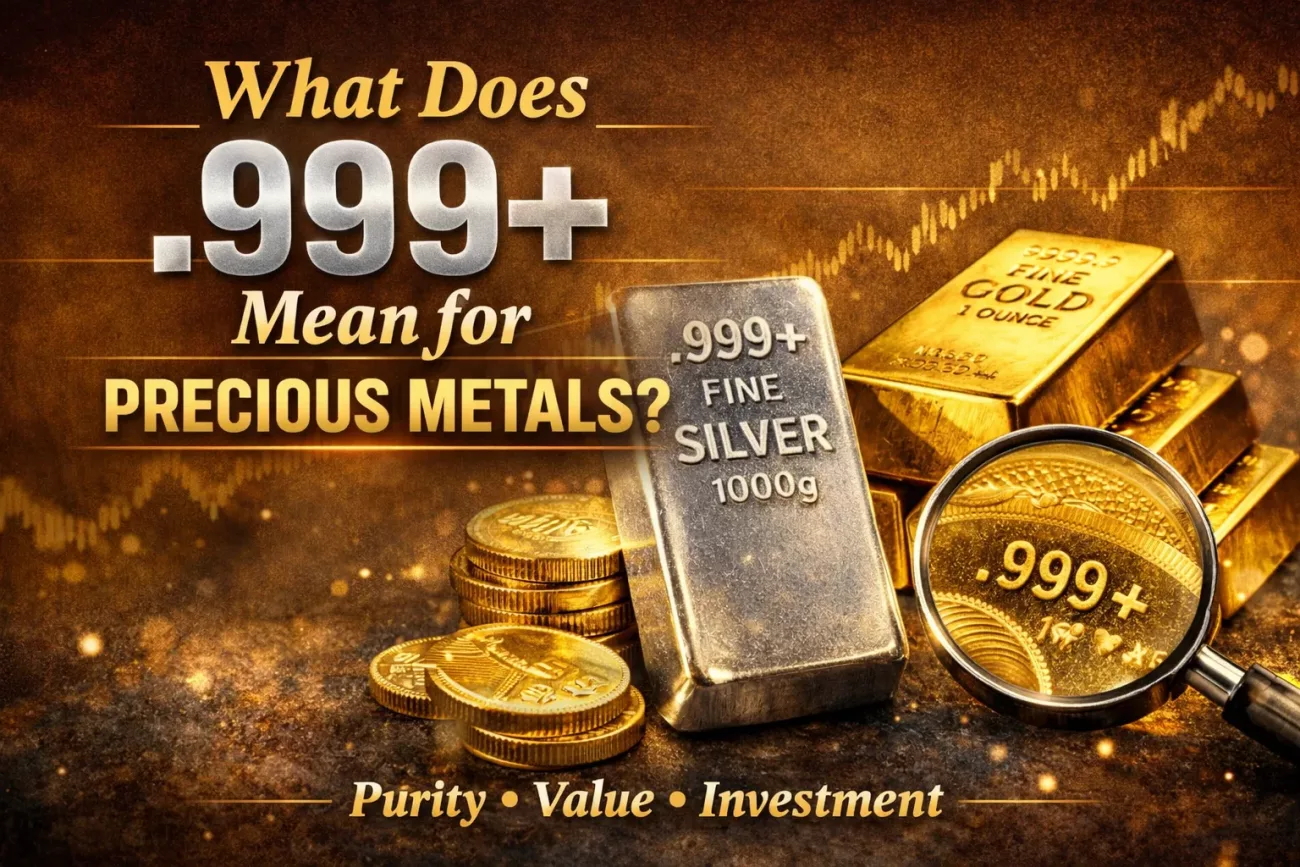
If you’ve ever browsed gold or silver bars online, you’ve probably seen labels like .999, .9999, or .999+ fine stamped on them. For many buyers—especially first-time investors—this raises a simple but important question:
What does .999+ actually mean, and does it really matter?
The short answer: yes, it matters—but maybe not in the way you think.
In this guide, we’re going to break it all down in plain English. No confusing jargon. No overcomplicated math. Just a clear explanation of what .999+ means, why it exists, how it affects pricing, and how you should think about purity when buying precious metals.
By the end, you’ll feel confident reading purity stamps and making smarter bullion decisions—whether you’re buying gold, silver, platinum, or palladium.
What Does .999+ Mean in Precious Metals?
Let’s start with the basics.
When you see .999, it refers to the purity of a precious metal. Specifically, it means the metal is 99.9% pure. That purity is measured in parts per thousand, also called fineness.
So:
- .999 fine = 999 parts pure metal out of 1,000
- The remaining 0.1% is usually trace elements from refining
Now, what about the “+” in .999+?
The plus sign means the purity is equal to or greater than .999. In other words, the metal is at least 99.9% pure—but it could be slightly higher. Many refiners use .999+ when the exact fineness may vary slightly above 99.9% but isn’t specified down to four or five decimal places.
You’ll commonly see .999+ used for:
- Silver bars and rounds
- Some gold bars
- Industrial-grade bullion
- Products where purity exceeds .999 but isn’t marketed as .9999
It’s a way of saying: this is investment-grade metal, without over complicating the label.
Why Purity Matters When Buying Precious Metals?
Purity isn’t just a technical detail—it plays a real role in value, liquidity, and trust.
Here’s why it matters:
1. Market Acceptance
Metals with recognized purity levels (.999, .9999) are easier to sell worldwide. Dealers, investors, and vaults instantly know what they’re dealing with.
2. Pricing and Spot Value
Precious metals are priced based on pure metal content. Higher purity means you’re paying closer to the true spot price of the metal itself.
3. Investment Confidence
When you buy .999+ fine bullion, you’re buying metal that meets modern investment standards. There’s no question about quality or legitimacy.
4. Resale Simplicity
When it’s time to sell, higher-purity metals are faster to liquidate and often come with fewer questions from buyers or dealers.
That said—higher purity doesn’t automatically mean better investment. Context matters, which we’ll get into shortly.
Understanding Different Purity Levels (.995 vs .999 vs .9999)
This is where many buyers get confused, so let’s simplify it.
.995 Fine
- 99.5% pure
- Common in older gold bars (especially European)
- Still considered investment-grade
- Slightly lower premium than .999 or .9999
.999 Fine
- 99.9% pure
- Extremely common for silver bullion
- Widely accepted globally
- Often stamped as .999 or .999+
.9999 Fine (Four Nines)
- 99.99% pure
- Popular for modern gold bars and coins
- Often marketed as “ultra-pure”
- Slightly higher premium
.99999 Fine (Five Nines)
- 99.999% pure
- Rare, mostly collector or specialty products
- Premiums can be high
- No major resale advantage for most investors
Important takeaway:
For most investors, the difference between .999 and .9999 has very little impact on real-world value. The market cares more about weight, authenticity, and recognizability than microscopic purity differences.
Does .999+ Mean Better Quality?
Not necessarily—this is where marketing comes in.
A .999+ bar isn’t automatically “better” than a .9999 bar in terms of:
- Investment returns
- Liquidity
- Safety
What matters more is:
- Who refined it
- Whether it’s authentic
- Market demand
- Premium paid over spot
A trusted .999+ silver bar from a reputable refiner can be just as smart an investment as a .9999 product—sometimes smarter if the premium is lower.
How Purity Affects Premiums and Pricing
When buying bullion, you’ll always pay:
Spot Price + Premium
Purity can influence that premium, but it’s not the only factor.
What Goes Into a Premium?
- Purity level
- Brand or refiner reputation
- Size (smaller bars usually have higher premiums)
- Market demand
- Manufacturing costs
For example:
- A 1 oz .9999 gold bar may cost more than a .999 gold bar—even though the difference in actual gold content is tiny.
- In volatile markets, premiums can spike regardless of purity.
Smart buyers focus on total cost per ounce, not just the number of nines stamped on the metal.
How Mints and Refiners Guarantee Purity
Reputable mints don’t guess purity—they verify it.
Here’s how:
Assay Certification
Most bars come with:
- Weight
- Purity
- Refiner mark
- Serial number (for larger bars)
Common Testing Methods
- XRF testing (non-destructive)
- Fire assay (used by refiners)
- Specific gravity testing
- Ultrasound testing for larger bars
When buying from a trusted source like BullionFortune, you’re not relying on blind trust—the products are sourced from recognized refiners who stand behind their purity claims.
Is .999+ Better for Gold or Silver?
It depends on the metal.
Silver
- .999 is the industry standard
- .999+ is extremely common
- Higher purity rarely affects resale value
Gold
- .999 and .9999 are both excellent
- .9999 is more common in modern gold bullion
- Older or larger bars may still be .995 or .999
Platinum & Palladium
- Often .9995 fine
- Industry-standard for investment products
Again, purity must be evaluated in context, not isolation.
Common Buyer Mistakes Related to Purity
Let’s clear up a few misconceptions:
❌ “Higher purity always means higher profit”
Not true. Premiums matter more than purity past .999.
❌ “.999+ is vague or lower quality”
Wrong. It simply means “at least .999 fine.”
❌ “Collectors should always buy the purest metal”
Collectors value rarity and condition more than extra nines.
❌ “Purity protects against counterfeits”
Authenticity does—not purity alone.
Practical Tips for Buyers
If you’re shopping for precious metals and wondering how much purity should influence your decision, here’s some real-world advice:
- Focus on recognized standards (.999, .9999)
- Buy from trusted dealers, not unknown sellers
- Compare premiums, not just purity
- Avoid paying extra for purity that won’t matter at resale
- Understand your goal (investment vs collecting)
For most investors, .999+ fine bullion hits the sweet spot between purity, price, and liquidity.
Final Thoughts: Does .999+ Really Matter?
Yes—but only when you understand what it actually means.
.999+ doesn’t mean “almost pure.”
It means investment-grade metal that meets or exceeds global standards.
The biggest mistake buyers make isn’t choosing .999 over .9999—it’s focusing on purity alone while ignoring premiums, authenticity, and market demand.
When you understand purity in context, you stop buying emotionally and start buying strategically.
If your goal is long-term wealth preservation, portfolio diversification, or simply owning real, tangible assets, understanding labels like .999+ gives you an edge—and confidence.
And that’s what smart precious metals investing is really about.


Leave a comment