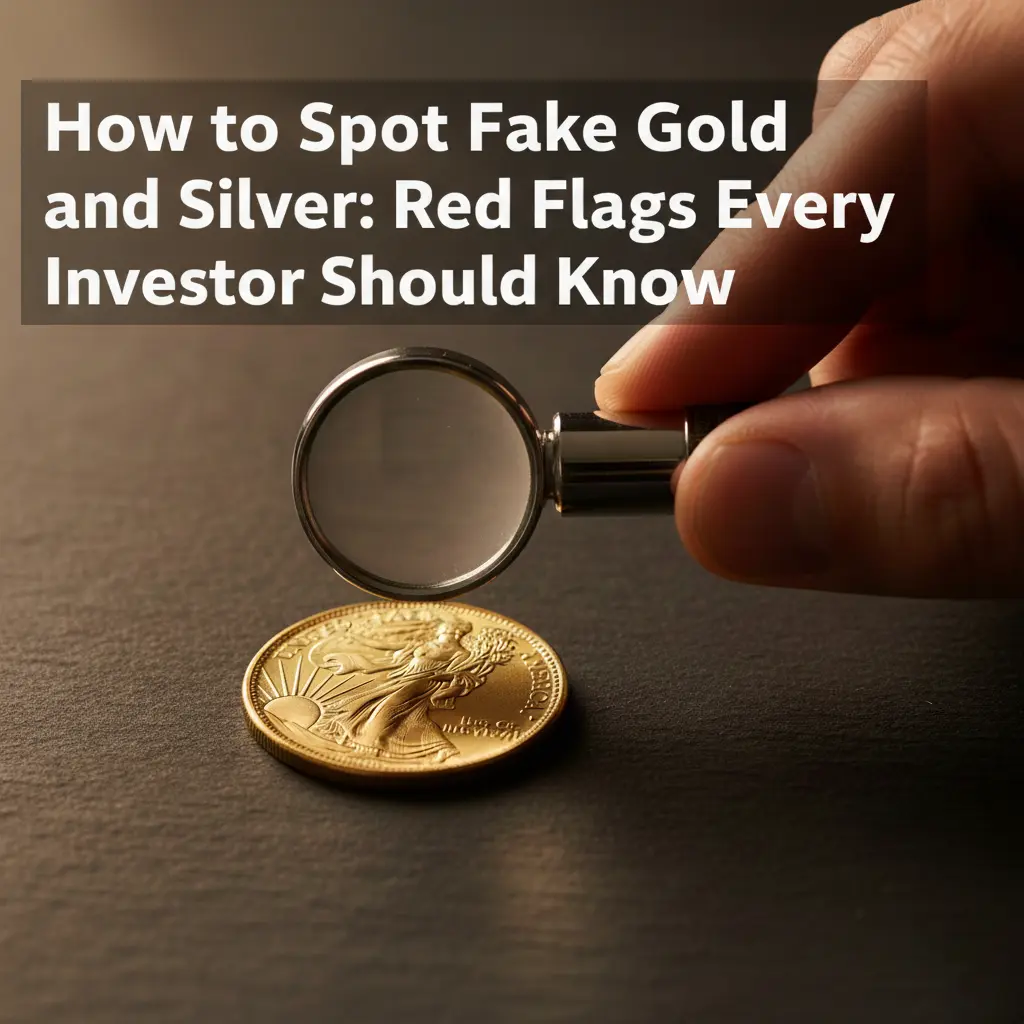
Counterfeit gold and silver aren’t rare anymore. As demand for physical bullion keeps rising, so does the creativity of counterfeiters. Some of today’s fakes look surprisingly convincing at first glance — clean printing, proper dimensions, even “official-looking” certificates. But if you know what to look for, the red flags start to appear quickly.
This guide walks you through the most reliable ways to identify fake gold and silver, from basic checks to more advanced testing. Think of it as a practical reference you can return to whenever you’re evaluating a new piece.
Why Fake Bullion Exists (and Why It’s Getting Better)
Counterfeiters follow money, and precious metals are profitable. A bar filled with tungsten — a metal with a density close to gold — can fool someone who’s only checking the weight. Silver-plated copper coins with perfect designs can slip through casual inspections.
The point is simple: if you’re buying bullion, spotting fakes is a skill you must have. It only takes one bad transaction to lose hundreds or thousands of dollars.
Let’s break down the red flags.
1. Red Flags You Can Spot With Your Eyes
Visual inspection doesn’t catch everything, but you’d be surprised how many counterfeits fail the basics.
Incorrect or soft details
Real mints use high-precision dies. Edges are sharp. Text is clean. Patterns are crisp.
Fakes often show:
- Blurred lettering
- Uneven fonts
- Soft or “melted” edges
- Slightly incorrect artwork
If something looks almost right but not quite, don’t ignore it.
Wrong color tone
Fake gold sometimes shows a slightly yellowish or orangish tint. Fake silver may look too shiny or too dull.
- Gold should have a consistent, rich, warm tone.
- Silver should appear cool and bright, not chrome-like.
Subtle color issues are one of the easiest giveaways.
Suspicious surface texture
Genuine bullion feels refined. Counterfeits might show:
- Bubbles
- Tiny pits
- Irregular polishing
- Uneven brushing patterns
A quick look under good lighting exposes a lot.
2. Weight & Dimensions: Simple but Essential Checks
Even high-quality fakes often slip up here.
Always check weight
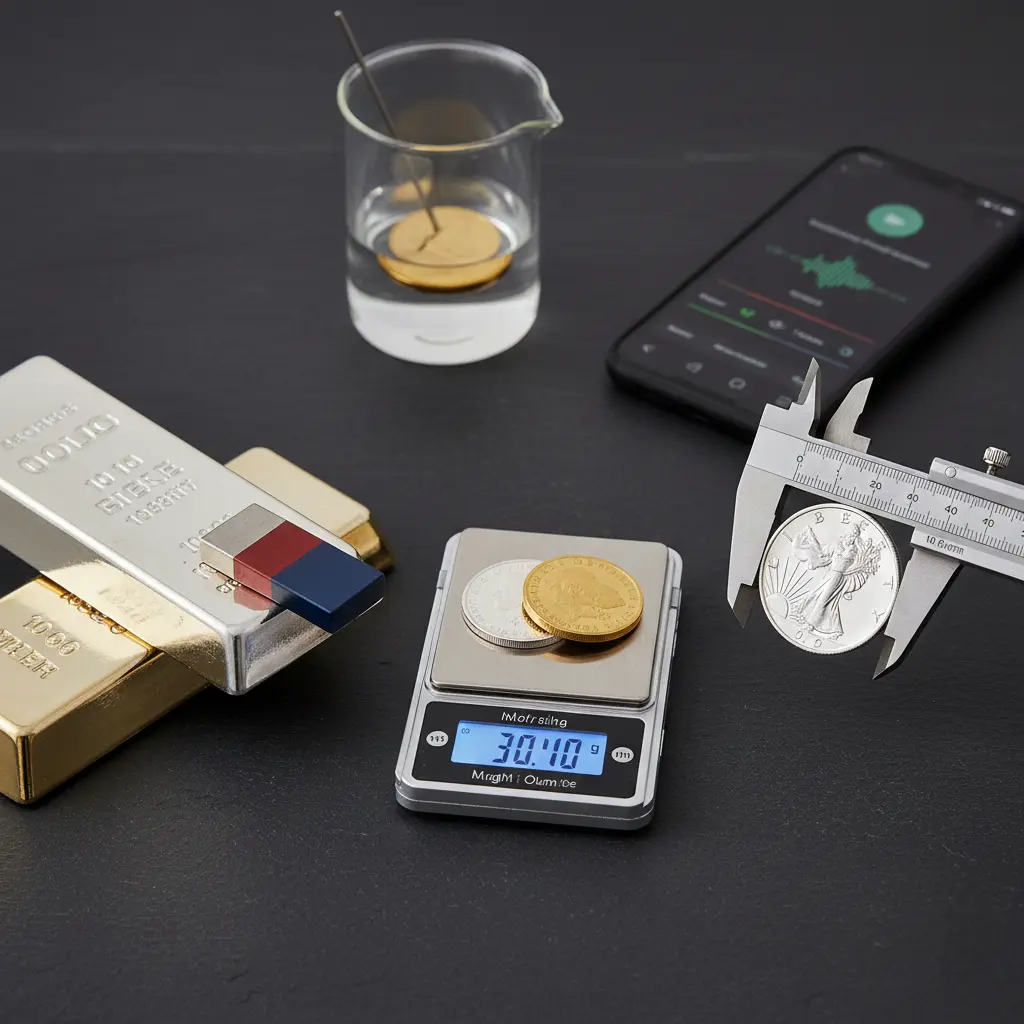
Every bullion product has a precise standard weight. Use a digital scale with at least 0.01 g accuracy.
Examples:
- 1 oz gold coin → 31.10 g
- 1 oz silver coin → 31.10 g
- 100 g gold bar → 100.00 g (with tiny tolerance)
Anything noticeably off is a problem.
Measure the diameter and thickness
Fake coins and bars often match the weight but not the size.
Use a digital caliper to confirm:
- Diameter
- Thickness
- Edge height
Counterfeiters can match one variable, but matching all three is harder.
Density test (simple calculation)
If you want to go deeper, density can reveal tungsten-filled gold bars or copper-filled silver bars.
You’ll need:
- Weight
- Water displacement measurement
Then calculate:
Density = Weight / Volume
Compare with real values:
- Gold: 19.32 g/cm³
- Silver: 10.49 g/cm³
If the number is far off, it’s not real bullion.
3. Magnet Test: Quick Screening Method
Precious metals are non-magnetic.
If a magnet sticks strongly → fake.
But here’s a detail many beginners miss:
Some counterfeiters use non-magnetic metals too.
So the magnet test is best used as a fast “eliminate the obvious fakes” tool.
A sliding magnet test is even better:
Tilt a silver bar and slide a strong neodymium magnet down the surface. Real silver will create a slow, smooth slide because of eddy currents. Fake metals won’t.
4. Sound Test (Ping Test) for Silver Coins
Silver has a very distinct, crisp, bell-like ring when tapped gently.
How to do it:
- Hold the coin between two fingers.
- Tap with another coin or a non-metallic object.
- Listen to the sound.
Genuine silver rings with a long, clear tone.
Plated or mixed metals create a dull, short clink.
Several apps can compare frequencies, but your ears alone can catch many fakes.
5. Look Closely at Packaging and Certificates
Counterfeit packaging often looks professional — until you compare it to real examples.
Check for:
- Wrong fonts
- Incorrect hologram style
- Bad alignment
- Poor print quality
- Misspelled words
- Low-resolution QR codes
If you’ve never seen authentic packaging, take a moment to find verified images online and compare.
Certificates of authenticity
COAs can be faked too.
Look for:
- Proper serial numbers
- Matching numbers on the bar
- High-quality card stock
- Clean printing
A mismatched serial number is an instant disqualification.
6. Red Flags About the Seller
The bullion itself matters, but the source often tells the bigger story.
Avoid sellers who:
- Offer prices far below spot
- Have no physical address
- Are reluctant to share photos
- Can’t explain the origin of the item
- Don’t offer returns
- Push you to “buy fast before someone else takes it”
Legitimate sellers are transparent.
Shady sellers rush and deflect questions.
Where reliable buyers get metals:
- Reputable online dealers
- Established precious metal shops
- Authorized mint distributors
- Well-known marketplaces with strong buyer protection
Buying from random social media pages is one of the most common causes of fraud cases today.
7. Advanced Tools for Accurate Verification
If you want to be completely sure, these tools make counterfeiting almost impossible:
Electronic precious metal testers
Devices like Sigma Metalytics scanners analyze the metal’s resistivity.
They can detect:
- Tungsten cores
- Plated surfaces
- Incorrect alloys
These are widely used by dealers.
XRF Analyzer (X-Ray Fluorescence)
This is what many professional shops use.
It tells you the exact composition of a piece without damaging it.
You’ll instantly know if something is:
- 24K, 22K, 18K, etc.
- Sterling silver vs plated
- Gold-plated tungsten
- Silver-plated brass
These machines are expensive, but great if you handle a lot of bullion.
Ultrasound testing
Ultrasound devices measure how sound waves travel through the metal.
This quickly detects fake bars filled with tungsten or lead.
Dealers often combine ultrasound + electronic testing for high-value bars.
8. Specific Red Flags to Watch for in Gold
Gold fakes tend to be more sophisticated because the profit margin is higher.
Common gold counterfeit signs:
- Tungsten-filled bars
- “24K” stamps on items that feel too light
- Poorly aligned serial numbers
- Incorrect karat markings
- Hollow jewelry pieces
- Edges that feel sharp instead of smooth
Also, some scammers plate a thin layer of real gold over base metal.
Testing tools help detect this fast.
9. Specific Red Flags to Watch for in Silver
Silver is cheaper, so the fakes are usually more careless.
Common silver counterfeit signs:
- Copper or brass core visible on scratches
- Chrome-like overly shiny surfaces
- Incorrect reeding (edge pattern) on coins
- Slightly oversized bars
- Dull sound during the ping test
Silver counterfeits often reveal themselves quickly if you know these details.
10. High-Risk Items to Be Extra Careful With
Some products get counterfeited far more than others.
Be cautious with:
- Popular 1 oz coins (Maple Leaf, Eagle, Krugerrand)
- 10 oz and kilo silver bars
- Gold bars from unknown private mints
- Secondary-market items without packaging
- Jewelry sold “as 22K or 24K” without hallmark verification
Hard truth: if a product is extremely popular, scammers target it.
11. Tips to Reduce Your Risk Long-Term
Spotting fakes is useful, but avoiding them entirely is even better.
Here’s how you lower risk significantly:
• Buy from trusted sources
Not the cheapest source — the safest source.
• Learn what real bullion looks like
Once you’ve seen enough genuine items, fakes stand out quickly.
• Keep a small testing kit
Scale, caliper, magnet — inexpensive and effective.
• Document your purchases
Store receipts, photos, and serial numbers.
If authentication is ever needed, this helps.
• Don’t get tempted by “too good to be true” offers
Most scams start with unbelievable pricing.
• Stay updated
Counterfeit techniques keep evolving.
Refreshing your knowledge once in a while matters.
Final Thoughts
Spotting fake gold and silver is part skill, part habit. The more you practice, the faster your eyes catch little inconsistencies. You don’t need to be a scientist — just observant and cautious.
Each check on its own helps, but combining multiple checks is what gives you confidence:
- Visual inspection
- Weight + dimensions
- Magnet test
- Packaging review
- Seller verification
- (Optional) advanced metal testing
When all these line up cleanly, you’re dealing with genuine bullion.
Stay connected with Bullion Fortune for regular updates on bullion scams, authenticity tips, and smart precious metal buying strategies.( Instagram )

Leave a comment